The 2026 Las Vegas Market Reality
At Palast Realty Group, we rely on 30 years of empirical market data to guide our clients through complex investment landscapes. As of mid-2026, the Las Vegas Valley presents a highly calculated opportunity for real estate investors. The median single-family home price has stabilized at $498,000, marking a period of sustainable valuation rather than the volatile spikes seen in previous years. This stabilization, combined with an active inventory supply of roughly five months, has shifted negotiating leverage firmly back into the hands of buyers. For investors focused on cash flow and equity stability, understanding these current market metrics is the first step in executing a profitable acquisition strategy.
Decoding Current Rental Yields and Capitalization Rates
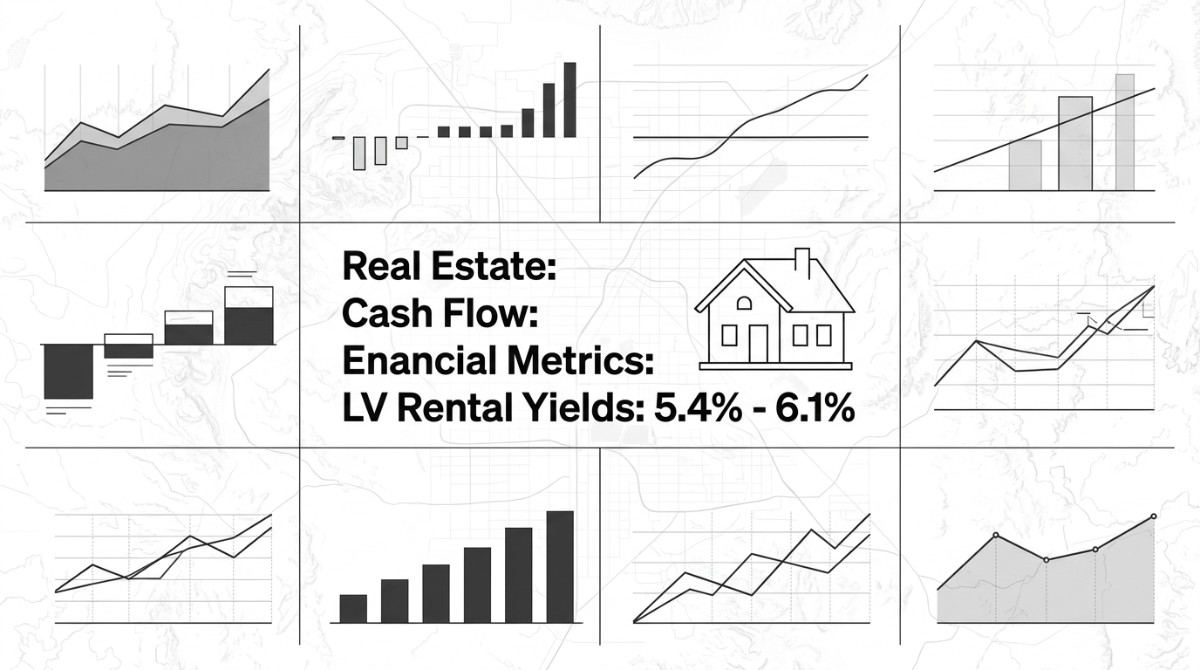
Our analysis of recent transaction data reveals that single-family rental yields are currently running between 5.4 percent and 6.1 percent gross in target zip codes such as Henderson 89015 and North Las Vegas 89031. To understand the true profitability of these assets, we must look at capitalization rates (the expected rate of return generated by a property, calculated by dividing the net operating income by the current market value). By factoring in current average two-bedroom rents of approximately $1,850 and low multifamily vacancy rates hovering around 5.4 percent, investors can project reliable cash flow.
Historically, the Las Vegas rental market experienced rapid, unsustainable rent growth between 2019 and 2022. The current normalization of rent prices is actually a long-term advantage for institutional and private investors alike. Stable rent growth reduces tenant turnover and minimizes vacancy periods, which directly protects the investor’s bottom line. When we analyze properties in master-planned communities across Summerlin and Skye Canyon, the data consistently shows that steady occupancy yields higher long-term returns than volatile, high-turnover rental models.
The Macro-Economic Advantages of Nevada Real Estate
National real estate trends must always be contextualized within the specific economic landscape of Nevada. The structural advantages of owning rental property in Clark County are significant. Nevada enforces zero state income tax, which immediately improves the net yield of any rental portfolio compared to neighboring states like California. Furthermore, the lack of rent control allows property owners to adjust pricing in accordance with true market demand, ensuring that cash flow keeps pace with inflation.
Property taxes in Nevada also provide a distinct layer of equity protection. With property taxes statutorily capped at a maximum increase of 3 percent per year for primary residences and up to 8 percent for investment properties, investors are shielded from sudden, drastic increases in holding costs. This predictable expense model is a primary reason why out-of-state capital continues to flow into the Las Vegas Valley, driving long-term property appreciation.
Leveraging Seller Concessions and Builder Incentives
The current inventory landscape has created a prime environment for strategic acquisitions. We are currently seeing seller concessions (financial contributions from the seller used to cover a buyer’s closing costs or temporarily lower their mortgage interest rate) in approximately one out of every three closed transactions. This metric indicates that sellers are willing to negotiate on terms that directly benefit an investor’s initial capital outlay.
In the new construction sector, particularly within guard-gated neighborhoods and 55+ active-adult communities, builders are offering aggressive incentives to maintain their sales velocity. We are tracking select builder incentives that include mortgage rate buydowns as low as 4.99 percent. Securing a rate buydown (a financing technique where the buyer or seller pays an upfront fee to lower the interest rate for the first few years of the loan) significantly decreases monthly debt service. This strategy transforms an average rental property into a high-performing, cash-flowing asset from day one.
Inventory Absorption and Strategic Valuation
To accurately time an investment, we closely monitor inventory absorption (the rate at which available homes are sold in a specific market over a given time period). The Las Vegas Valley is currently experiencing a balanced absorption rate, meaning properties are sitting on the market long enough for investors to conduct thorough due diligence without the pressure of bidding wars. This environment allows us to target aging tract homes in older Las Vegas zip codes that require cosmetic updates, as well as turn-key single-story homes in Henderson, with precision.
Long-term valuation in Las Vegas is supported by massive public infrastructure investments and continuous job creation in sectors outside of gaming and hospitality. The expansion of healthcare, logistics, and data centers in North Las Vegas ensures a steady pipeline of high-earning tenants. When you combine this economic diversification with the current pricing leverage, the data clearly points to a strong buying window for calculated investors.
Next Steps for Investors
The numbers dictate the strategy. With median prices stabilizing, rental yields holding strong above 5 percent, and seller concessions readily available, the current Las Vegas market offers a distinct mathematical advantage for those ready to deploy capital. We do not rely on speculation. We rely on 30 years of proven, data-driven methodologies to identify properties that meet strict investment criteria.
To review the latest capitalization rate models for specific neighborhoods or to discuss how builder incentives can improve your portfolio’s cash flow, we advise you to treat your next acquisition as a calculated business decision. Contact our team to book a strategy call and leverage our proprietary market analysis tools at Palast Realty Group.